Ten years ago, getting found meant ranking in a Google search and maybe running an ad in the local paper. Today the path looks completely different. Before someone bids in your auction — or picks up the phone to ask about selling their late father's estate — they've usually already Googled your name, skimmed your reviews, glanced at your location on the map, maybe watched a video, and in a fast-growing number of cases, asked an AI assistant like ChatGPT or Google's AI to simply tell them who to call.
Here's the good news: you do not need to be a tech company to win at this. Almost everything that moves the needle is practical, low-cost or free, and something you can start this week. This guide walks through exactly what to do — to bring in more bidders on the buy side and more consignors on the sell side.
The one shift worth understanding
You don't need the jargon. You just need this: people used to get a list of links and sort through it themselves. Now, more and more, they get an answer. They ask a question and Google or an AI assistant hands back a short recommendation — often just a few trusted local names — and the searcher picks one.
So the game has changed from "show up somewhere on page one" to "be the obvious, trustworthy local name that both people and these AI tools point to." And the way you become that name is refreshingly old-fashioned: be genuinely visible in your community, make it easy to trust you, and put real, useful information out into the world. The tools simply reward the businesses that are already doing the right things.
Here's how to be that business.
Play 1: Own your Google listing — it's your new front door
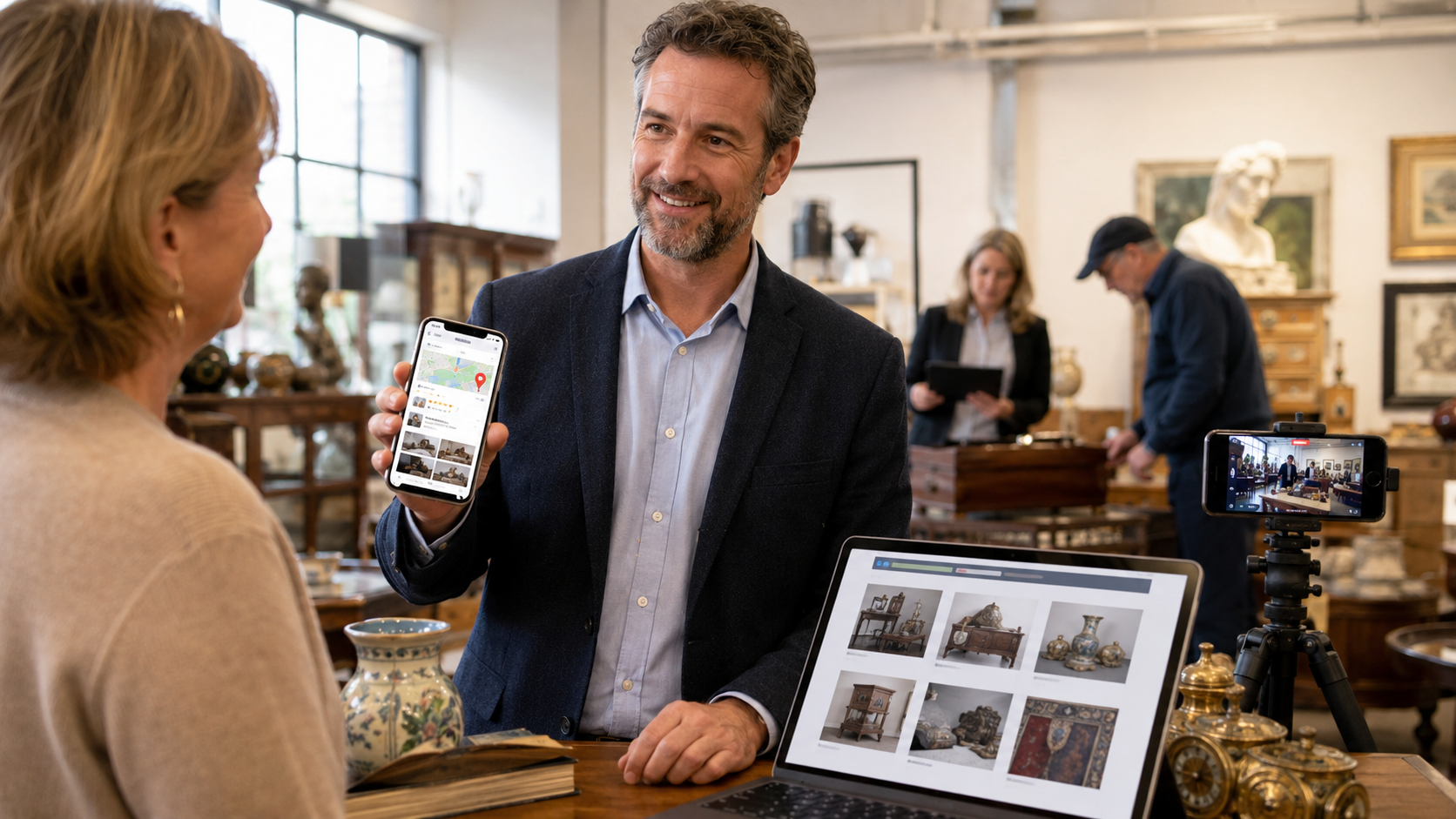
Before anyone visits your website, they see your Google listing: the box that pops up with your name, hours, photos, reviews, and a map pin. For most auction companies this is the single most important piece of online real estate, and it's free. It's also one of the main places both Google and AI assistants pull from when they recommend a local business.
What to do this week:
- Claim and completely fill out your Google Business Profile — every field. Hours, service area (list the counties and towns you cover), phone, website, a clear description of what you sell, and the right business categories ("Auctioneer," "Estate Liquidator," and so on).
- Add real photos and keep adding them: your team, your gallery, recent items, a packed sale day. Profiles with fresh photos get far more clicks and calls.
- Use the "posts" feature to announce upcoming auctions, the same way you'd post on Facebook. It takes two minutes and keeps your listing active.
- Make sure your business name, address, and phone number are written exactly the same way everywhere they appear online — your website, Facebook, directories, everywhere. When the details don't match, both Google and AI tools get confused about who you are and trust you less.
Play 2: Make reviews a habit, not an afterthought
Reviews are the closest thing to word-of-mouth that lives online. They're what a nervous first-time bidder reads before registering, what an executor reads before trusting you with a houseful of belongings, and increasingly one of the strongest signals AI assistants use when they decide which local company to recommend. A company with 150 recent, positive reviews will get recommended over one with nine, almost every time.
Most auctioneers under-ask. Fix that by making it automatic:
- Ask every single buyer and every single seller, right at the moment they're happiest — when a buyer picks up a great deal, or when you hand a consignor their check.
- Make it one tap. Put a QR code on your pickup counter and on pickup paperwork that goes straight to your Google review page. Add the link to your follow-up emails and texts.
- Respond to every review, good or bad. A gracious reply to a complaint reassures the next reader far more than a wall of perfect five-stars does.
- Don't forget seller reviews specifically. Buyer reviews bring bidders; seller reviews bring consignments. Ask happy consignors to mention what they sold and how the process went.
Play 3: Put yourself on video
Video is the most underused tool in the auction business, and it does two things nothing else does as well: it calms nervous bidders, and it answers sellers' questions before they even ask. YouTube is also the second-largest search engine in the world, its videos show up right inside Google, and AI assistants increasingly pull from video too. You do not need a studio — a phone and decent light are plenty.
Easy videos that earn their keep:
- Auction previews. A 60-to-90-second walk-through of the highlights of an upcoming sale. Post it on YouTube, then your website, Facebook, and Instagram.
- "How our auctions work." One simple tutorial on registering and bidding. This single video will remove the biggest barrier first-time bidders face.
- "What sold for what" recaps. People love seeing results, and these quietly tell future sellers that you get strong prices.
- "Thinking of selling?" A friendly two-minute explainer of how consigning works — what you handle, the timeline, how they get paid.
Film once, then cut the footage into short clips for Facebook, Instagram, and TikTok. One sale day can give you a month of content.
Play 4: Become the familiar local name
People hire the auctioneer they already feel they know. Your job is to be a steady, helpful presence in the places your community already gathers online — not by blasting ads, but by being useful. This is also where your seller pipeline lives, because the person clearing out a home is asking neighbors and local groups for a recommendation long before they search Google.
Where to show up and how:
- Facebook groups and Nextdoor. Claim your business page on both. Then actually participate in local buy-sell groups and neighborhood threads. When someone asks "what's this old tool worth?" or "who do I call to sell my parents' house contents?", be the friendly expert who answers helpfully. That goodwill turns into consignments.
- Be the local "what's it worth" expert. Offer free appraisal days. Volunteer to comment for the local paper or TV station when there's a story about collectibles, estates, or downsizing. Sponsor a community event. Familiarity builds trust, and trust is what both sellers and the search tools reward.
- Build referral relationships with the people sellers talk to first: estate attorneys, real estate agents, senior move managers, downsizing and clean-out services, and bank trust officers. A handful of these relationships can become your most reliable source of consignments — and they're entirely offline relationships that pay off online and off.
Play 5: Make your listings do the selling
Your inventory is your marketing. Every well-photographed, fully described lot is a page that can show up in Google, get surfaced by AI shopping answers, and convince a buyer to bid. The pros agree on what matters most: the team at Bring a Trailer flatly calls photography the key to a successful auction, and eBay says complete item details are one of the best ways to help buyers find an item in the first place.
For every lot, make these the default:
- Lots of clear photos from multiple angles, in good light, including close-ups of labels, markings, and any flaws. More good photos means more confidence and higher bids.
- A complete, plain-English description: what it is, the brand or maker, size and measurements, condition (including the honest flaws), and the practical stuff — payment terms, pickup location, and pickup dates.
- Answers to the questions buyers always ask, right there in the listing, so nobody has to email you to bid.
This isn't just good marketing. When your listings are this clear, the search and AI tools can actually understand what you're selling and show it to the right people. Vague, photo-light listings are invisible to buyers and machines alike.
Play 6: Publish what only you know
This is the most overlooked opportunity in the whole industry, and it's the one that gets you recommended by AI. Those tools love to cite specific, original, genuinely useful information — and you generate exactly that every single sale, then usually throw it away.
When researchers studied what makes an AI assistant mention a business, the winners weren't the ones with clever tricks (in fact, the old keyword-stuffing tricks actually backfired). The winners were the ones offering clear answers, real numbers, and useful detail. You have all three. Start turning them into simple pages and posts:
- Results recaps. "Here's what sold at last weekend's farm equipment auction." You have the data; nobody else does.
- Local market notes. "What estate jewelry is bringing in our area this year." A short, honest take makes you the local authority.
- Plain-language guides for the questions you answer on the phone every day: How to sell an estate. What to expect at your first online auction. How to downsize a lifetime of belongings.
- A real FAQ answering the actual questions buyers and sellers ask. These are exactly the kind of clear answers AI tools pull from when someone asks a question in your area.
You don't need to write often. A couple of genuinely useful pages a month, drawn from things you already know, will do more than a year of generic posts.
Play 7: Build a list you own
Everything above helps strangers find you. This play is about never having to re-win the people who already know you. Social media and search can change the rules overnight; a list of people who asked to hear from you can't be taken away.
- Collect an email address — and ideally a cell number for texts — from every bidder, every consignor, and every inquiry. Make signup obvious on your website and at every sale.
- Then actually use it: upcoming auction announcements, sale previews, last-chance reminders before a sale closes, results afterward, and direct "we're seeking consignments for our next sale" calls.
- Sort your list by what people buy and where they are, so a tool-and-equipment buyer hears about the right sales and a jewelry buyer hears about hers.
A healthy email and text list is the most valuable marketing asset most auction companies will ever build, and it costs almost nothing to start.
Play 8: Make it easy — and obvious — for sellers to choose you
Most auction company websites are built entirely for buyers and almost forget the sellers, even though a single good consignment can be worth more than a hundred bidders. Give sellers a clear, confident path:
- A dedicated "Sell with us" or "Consign" page that answers their real questions: what you sell, how the process works step by step, the timeline, and how and when they get paid.
- Proof, front and center: recent results, happy seller reviews, and a few before-and-after stories of estates you've handled.
- An easy way to start the conversation — a short form or a phone number with a real promise of a quick callback.
When a stressed executor lands on that page, you want them to think "these are clearly the people who do this all the time." That feeling is what turns a search into a signed consignment.
If you only do five things this month
You can't do all of this at once, so start here, in order:
- Claim and fully complete your Google Business Profile (Play 1).
- Put a QR code at your pickup counter and start asking every buyer and seller for a review (Play 2).
- Film one "how to bid" video and one auction preview, and post them on YouTube (Play 3).
- Build or fix your "Sell with us" page so it's clear and confident (Play 8).
- Start collecting emails at every sale and send one preview before your next auction (Play 7).
Those five alone will put you ahead of most auction companies in your market.
The bottom line
The tools have changed, but what works hasn't, really. Be easy to find on the map. Be easy to trust through reviews and video. Be genuinely present in your community. Put real, useful information out into the world. And keep a direct line to the people who already love your sales. Do that, and you'll be the name buyers bid with, the name sellers call, and the name the new AI assistants recommend when someone in your town asks who to use.

 Daniel P. West
.png)
 Daniel P. West : January 12, 2026
.png)
.png)