Retail returns are not a trickle anymore. They’re a flood.
When returns and overstock pile up, liquidation becomes the pressure valve. The operators who win in this space are the ones who can process inventory fast, list it cleanly, and run auctions on a steady cadence without chaos. That takes more than hustle. It takes a workflow built for volume and an auction platform that can keep up.
Below, we’re turning the key takeaways from a recent retail liquidation report into a practical playbook for auction businesses, liquidation warehouses, and anyone building a repeatable returns-auction operation. If you're super interested in the subject, you can also check out my LinkedIn article titled "The $800 Billion Opportunity Hiding in Retail Returns".
.
What Counts As Retail Liquidation Inventory
Most people hear “liquidation” and think “broken junk.” Real-life liquidation is broader than that, and understanding the mix helps you lot smarter and set bidder expectations.
Common liquidation streams include:
-
Customer returns: Often near-new, sometimes damaged, sometimes missing parts.
-
Overstock and shelf-pulls: New inventory that didn’t sell in time.
-
Closeouts: Discontinued lines, store closures, seasonal leftovers.
-
Salvage: Damaged or defective items sold for parts, repair, or scrap.
Condition drives everything in this business. Many operators grade inventory (New, Open Box, Used, Salvage) because bidders price risk, not just product.
Why Auctions Work So Well For Liquidation
Liquidation inventory has two big problems: volume and variability. Auctions handle both.
Auctions create urgency with a deadline, which helps you clear space and turn inventory into cash on a predictable schedule. Competitive bidding also gives you price discovery on weird, mixed, or hard-to-price items.
For buyers, the value is obvious: steep discounts, a steady supply of inventory, and the thrill of the bid. For sellers and operators, auctions help move high volumes without needing perfect SKU-level retail merchandising.
The Liquidation Auction Ecosystem (And Where You Fit)
Here’s the basic flow we see again and again:
Retailers, brands, and 3PLs offload returns and excess goods → liquidators receive truckloads → teams sort, test, lot, and list → auctions, pallet sales, bin stores, and wholesale channels move it downstream.
The market includes:
If you run a liquidation auction, you’re likely competing on one thing more than anything else: throughput. You don’t need perfection; you need repeatability.
The KPIs That Actually Matter In Liquidation Auctions
You can run liquidation auctions “fine” for a while without measuring much. Then you hit a wall. The report calls out the metrics that separate the operators who scale from the ones who stay stuck.
Recovery Rate
How much of retail value you recapture depends on category, testing, and description quality. Mixed returns often land in the rough range of 10%–30% of MSRP, with better results when manifests and testing are stronger.
Sell-Through Rate
If you’re relisting piles of no-sale lots, you’re burning labor and space. Many strong operators aim for 85%–95%+ sell-through per cycle and re-bundle leftovers quickly.
Lots Processed Per Worker Per Day
This is the heartbeat KPI. Your auction management lives or dies by how efficiently your team can receive, sort, photograph, and list.
Payment Defaults And Pickup Speed
Non-paying bidders and slow pickups create operational drag. Pickup turnaround time is also part of your brand, even if you’re “as-is.”
If you want a simple rule: every point of recovery and every minute of labor efficiency compounds at volume.
The “Life Of A Pallet” Workflow (A Practical Operations Map)
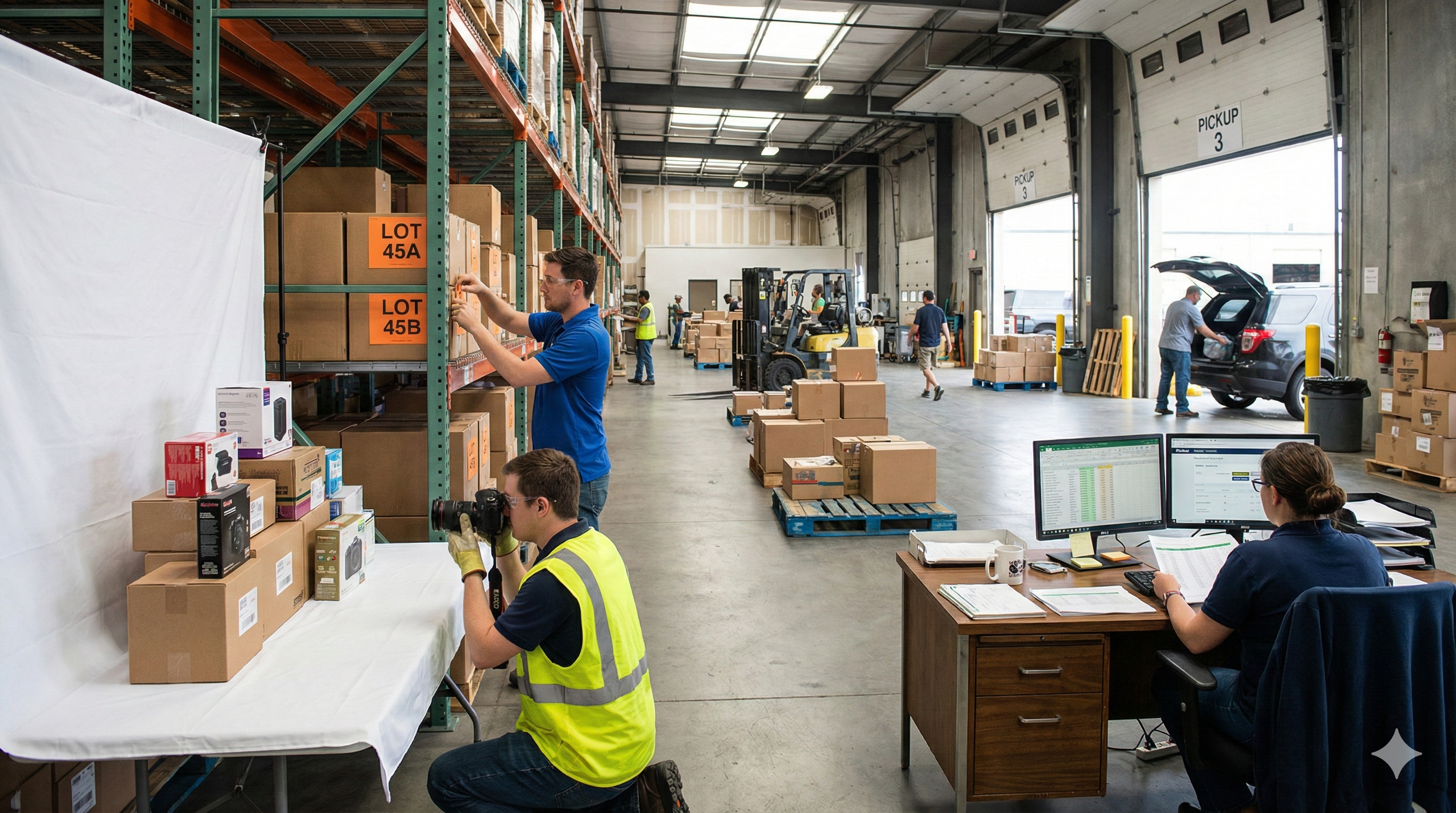
Most liquidation auctions follow a repeatable life cycle. When we map this out, it’s easier to see where the bottlenecks form, and what your auctioneer software needs to support.
Inbound Receiving
Truck arrives, manifests vary in accuracy, pallets get labeled and staged. Fast receiving matters because storage time is pure cost.
Triage, Sorting, And Testing
Inventory gets routed into streams: individual lots, bundle lots, pallet lots, bin store, wholesale, recycle. Electronics might be tested or marked untested. Hazmat and batteries need special handling.
Lot Creation
Lotting strategy is profit strategy.
High-value items usually go individual. Lower-value items get bundled to reduce listing labor. Mystery pallets can move leftovers, but they can also train bidders to pay less if overused.
Photography And Cataloging
Your photos and descriptions do two jobs:
-
set bidder expectations
-
prevent disputes later
Clear notes like “tested working” vs “for parts” change bidding behavior immediately.
Auction Listing And Close
Timed online auctions dominate, often with soft close rules. Payments are charged or invoiced right after close, with buyer premiums and tax applied.
Pickup, Disputes, And Returns Policies
Most liquidation sites run local pickup only. Efficiency here is a competitive edge. Some operators allow on-site testing windows; others allow refunds under strict conditions. A few use generous return policies as a trust builder.
Post-Auction Analytics
The best operators close the loop: what sold, what didn’t, which categories recovered best, and which suppliers are worth paying more for next time.
If you’re reading this and thinking, “We do most of that, but it feels manual,” you’re not alone. That’s usually a software problem, not a motivation problem.
What Liquidation Operators Need From Auction Software
Liquidation isn’t “normal auctions at a discount.” It’s high-volume inventory processing with auction sales attached.
The report highlights a key truth: every operation has workflow twists that demand configurable online auction tools.
Here are the software capabilities that show up over and over in successful operations:
Fast Lot Creation And Bulk Workflows
When you’re listing hundreds or thousands of lots, the system has to support rapid creation, templates, bulk photo handling, and easy duplication of similar lots.
Multi-Warehouse Support Without Chaos
If you have multiple locations, your auction platform should separate inventory, tax rules, and pickup windows by warehouse while still giving you consolidated reporting. Ideally, bidders can use one account across locations.
Consignor And Revenue-Share Accounting
Many liquidation operations are consignment or revenue-share arrangements. Your auction management system needs settlement reporting, fee calculations, and clean audit trails so you’re not living in spreadsheets.
Configurable Closing Rules
Soft close, staggered close, different bidding rules for different auction events: these aren’t “nice-to-haves” when you’re running nightly auctions and trying to keep bidder engagement high.
Pickup Scheduling And Fulfillment Support
Pickup is where reputations are made and lost. Scheduling, pickup codes, clear invoices, and staff-facing pick lists reduce lines and reduce labor.
Compliance And Risk Controls
Returns streams can include batteries, chemicals, or electronics with personal data. Flagging risky items, documenting disclaimers, and tracking data wipe steps can help you avoid painful problems later.
In plain terms: liquidation auctions scale when your auctioneer software supports your process instead of forcing you into a generic workflow.
A Simple Way To Think About Scaling
If we had to boil this down to one practical idea, it’s this:
Scaling liquidation auctions is a math problem:
-
lower cost per lot listed
-
higher sell-through
-
better recovery on the lots that matter
-
faster pickup and fewer disputes
Technology is the multiplier. The report calls out that top operators treat software as a strategic asset because it reduces labor, reduces errors, and keeps volume moving.
If you’re running a liquidation auction today, the goal isn’t to “add more inventory.” Inventory will find you. The goal is to build a machine that can process it without breaking your team.
Ready To Run High-Volume Auctions Without Spreadsheet Gymnastics?
If you’re building or scaling a retail returns operation, your auction platform needs to handle high throughput, flexible workflows, and clean back-office reporting.
TALK TO AN AUCTION SOFTWARE EXPERT

 Daniel P. West
.png)
 Daniel P. West : April 04, 2025
.png)
.png)